



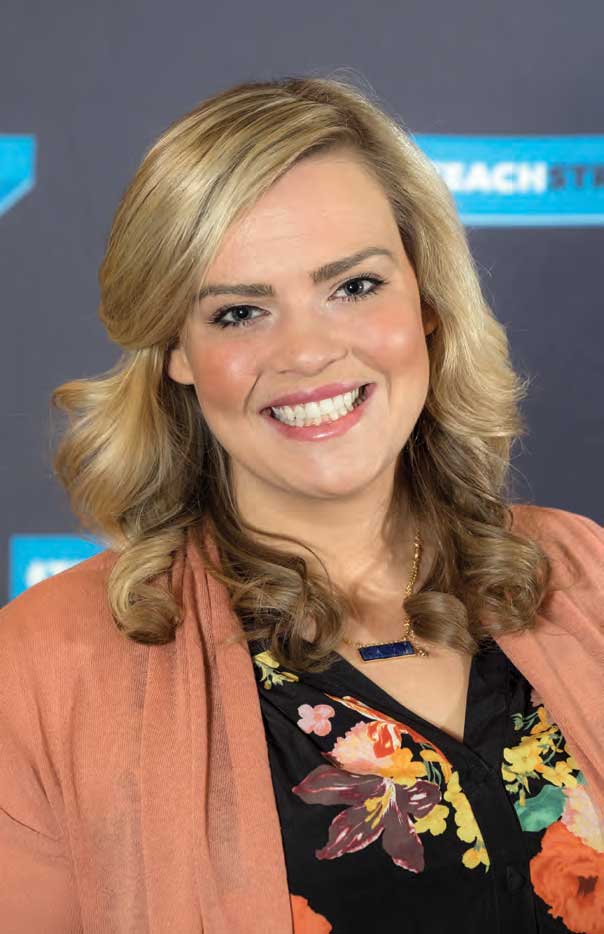
PHOTOS BY CHRIS WILLIAMS AND COURTESY OF GRAND CENTRAL PUBLISHING
She asked. They answered. During her inaugural year as a third-grade teacher, Kyle Schwartz created a simple lesson plan that quickly became a highly influential viral sensation. Author of the educational bestseller I Wish My Teacher Knew, Schwartz’s modest question continues to shed light on the often-unspoken needs of students in classrooms across the country.
The ever-philanthropic Schwartz reflects on her own childhood school experiences, the evolving landscape of teaching styles, and one timeless mantra she believes every educator—and parent—should remember… when a child speaks, listen.
“I taught public elementary school for ten years in Denver. I’m not currently teaching now, but I had done this lesson in my classroom where I asked kids to write down on a notecard, I wish my teacher knew… and then finish the sentence. It was kind of something I did in class that I never told anyone about. A few years later, I found one of these notes in my kitchen drawer that I had saved, and it said, “I wish my teacher knew I don’t have pencils at home to do my homework.” Obviously, seeing that statement, in a kid’s handwriting, even though you’re working in the school and know that’s their reality every day—it hits you. So I saw something worth sharing, and I took a picture of that one note and put it on my Twitter. I said, ‘Hey teachers, try this lesson in your classroom,’ and it took off without me. I did not have any anticipation of it getting any sort of attention, but teachers started to post their own experiences with it. Eventually a journalist must have seen this on Twitter and wrote an article—unbeknownst to me—and I got a call in my classroom during a lesson from my principal saying, ‘There’s a news truck outside. Do you want to tell me why?’ I told her, ‘It’s this note thing.’ They came back the next day, and it was on the news a bunch. But it really did go worldwide in every major media outlet, including India, Germany, Algeria… I’ve gotten messag-es from local newspapers all over. So it really does speak to this universality of the teacher-student relationship.
No matter where you are or what education system you’re in, there is this beautiful, powerful relationship that can be strengthened if we listen to kids and treat them as if they’re experts in their own learning. At the time of writing the books, I had only taught third grade. Later on, I taught second grade and reading, but really only in elementary schools. The notes in the book, I Wish My Teacher Knew, were submitted from kids throughout the country of all ages. One interesting thing that happened was that kids began to take it over. They started, unsolicited, making their own “I Wish My Teacher Knew” projects. It usually comes back around every couple of years, where I’ll see kids using it for their school newspaper or high school video assignments. I have also seen it used it for advocacy for specific groups. The National Down Syndrome Society, several groups for students with dyslexia, and different organizations use it as a tool for learning.
I definitely was part of a wave that was coming in education of more enlightenment around a whole-child perspective, understanding that things in a kid’s life, neighborhood, and community are going to affect the way they learn. Maybe it was a coincidence, but the education world really started to name and understand trauma as a real impact on a child’s functioning brain. There are a few buzzwords around it, but we understand how the brain works and we understand trauma. When I wrote the book ten years ago, no one was saying the word trauma in school. In my little corner in Denver, we were trying our best, but we were absolutely not saying that word and understanding that it impacts kid’s learning and what happens in the classroom. This lesson was a good illustration of that for people. During the pandemic, the book started selling more, which was very interesting because I think that was another part of a larger enlightenment in education. I was raised in the No Child Left Behind generation with standardized testing, and then this new way of looking at things really exploded right after I started teaching. Our focus was so much on testing and this weird internal competition between schools in a district, and I think the pandemic—more than creating issues—accelerated trends that we were already beginning to see. There became a necessity to find things to connect with kids about, and a larger conversation emerged about seeing education in a different way.
In teaching, we use a lot of euphemisms to talk about child poverty—it might be better if we were all more direct. Instead of saying, ‘Hey, we have a lot of kids in our city living in poverty,’ we use words like free and reduced lunch rate or underprivileged, but we need to be more open to the fact that we have a lot of kids who don’t have the resources they need and deserve. My school at the time was about 90% free and reduced lunch, which is a marker of child poverty, and it was for sure a factor in the day-to-day life at the school, in a way that people who are at a school that’s even 50% struggling don’t understand. It leads to a completely different dynamic for the kids because there is such a deep need for resources. From the research in the book, we find we really do have a lot of schools where kids who are living in poverty are placed together, and there’s many schools where no one is living in poverty that are together. There’s a lot of segregation economically and racially in our schools that’s continually happening to this day.”
What is the effect when families and the community become active partners in a child’s education? Schwartz describes her experience with families as very positive, emphasizing that involvement sends a strong message to students… what happens at school matters, and so do you.
“If I was listing the top 20 issues I had teaching, zero of them would have been parents. All of the parents loved their kids and wanted them to get a great education. They were rooting for their kids, rooting for the school, and it’s really important for parents to get involved in the academics. I know it can be intimidating to sit down with some homework that you haven’t done yourself in 20 years, but you can model that learning with your child. The one thing schools could do better is to ask families for their feedback and really look at all different types of families to see what they could actually use from their school. In Colorado at least, our schools are wildly, embarrassingly, humiliatingly, underfunded and you can’t just jump over that. Our schools here absolutely do not have enough resources to do their job. They’re doing better than they possibly should with what they have, and that comes down to the kids and how their experiences can be worsened because of that. But that is the experience of a lot of kids in school in America right now. On the micro-scale, for an individual child, I do think emotional intelligence is so important to teach in schools, and there’s some really great curriculum that most schools have access to. Some parents might say, ‘Well, I teach them things at home; you don’t need to in school,’ but don’t you want your kid in an education system where ev-ery child is hearing, ‘Here’s how to resolve a conflict’? Social-emotional lessons are so important to teach in class, and even things like body safety… it astounds me that it’s not required curriculum in every single school—and it’s really achievable.”
Recent surveys by the RAND Corporation via Education Week (news publication) note that just under a fifth of teachers self-report planning to leave or retire at the end of every school year due to high levels of stress, workload, and pay gaps.
“I stepped out of the classroom, and I was really burnt out because of some of the issues like the under-resourcing of the school, and I honestly had no life. I was working late every night, doing every extra thing because the need was so great. If I didn’t do it, it wouldn’t happen—like getting coats and shoes donated for the kids. It led into my nights and weekends, and I blame myself a little bit because of my lack of boundaries—but the system created it that way. For a while I worked with a curriculum company as a teacher ambassador for them. Now I work at a travel agency which is completely different, but interestingly enough, it uses some overlapping skills. I am also an associate board member of The Third Way Center, an organization here in Denver that I really love. The idea is that when kids get to the point where their only options are homelessness or juvenile detention, this is the third way. They have been around for fifty years, and were completely ahead of their time. The organization has five residential houses, complete wrap-around treatment therapy, round-the-clock therapists, family reunification therapists, drug and alcohol treatment for kids, they get them GED’s, get them back in school, and set them up for independent living in semi-independent apartments. That has been a great way to stay involved in my community from a development side.”
Once a reluctant student, Schwartz transformed her outlook as an adult and, for a time, devoted her life to en-suring no other child would endure the same struggle.
“I told the kids to really look for and pay attention to the safe, loving people in their lives—people who are celebrating them and who want to help and support them. My second book, I Wish for Change, is all about unleashing the power of kids to make a difference, student empowerment, and getting kids to turn their passions into something that can help their community. My experience in school as a student as a child was really bad. I hated school, it would have shocked me beyond belief that I would have chosen to work in a school. But what really changed everything for me, is when I got involved in an AmeriCorp program in Washington, D.C. called City Year. You’re a full-time volunteer in service to America, and part of that means working in a school in D.C., being there, meeting the kids, and building relationships with them. I loved that, and it became the highlight of my week, but it was really jarring to see the reality of what we let certain children experience in schoolVreal underfunding, real systemic issues, and kids in dire need of resources that they just aren’t going to get.
Juxtaposing that with my suburban childhood, where our school was nice and had safe playgrounds, clean floors and unbroken windows… it angered me to see that we allow some kids to have such poor-quality infrastructure in their schools. It made me really want to go back to my hometown and work in the schools in Denver. That’s what the change was. I really believe in education as such a beautiful value that we have in our country, but to see the reality of what we’re knowingly allowing to happen to some kids and not others prompted me to work in education. For me, it’s so easy to connect with kids and see the best in them. I loved working to better my city in my own little small way in my own little classroom.”
But what exactly inspired Schwartz to turn the viral notecard assignment into a printed work?
“I wanted to draw attention to certain experiences kids could have. It was also really phenomenal professional development for myself writing the book, because I was able to conduct a lot of research and see if it was just something I was experiencing in my classroom, or if it was a larger trend. Every chapter focuses on an issue, or a domain of pedagogy that can address a variety of student need, so it really is a high-level overview of the whole child relationship-building approach to teaching. I will say that teachers have always been doing this work, but it’s never been seen as a professional expertise. It was always, ‘Oh it’s so great that the kids really love you,’ or ‘It’s so nice that you’re so good with those hard kids.’ To really break it down—social-emotional learning, trauma-informed instruction—these are areas of professional expertise that we can develop as teachers and should value as a skill set.”
The books are finished for now, but the story is still being written in classrooms across the world. Schwartz’s words reach far beyond the walls of her school, echoed in students who have discovered their voice because someone cared enough to believe in them.