

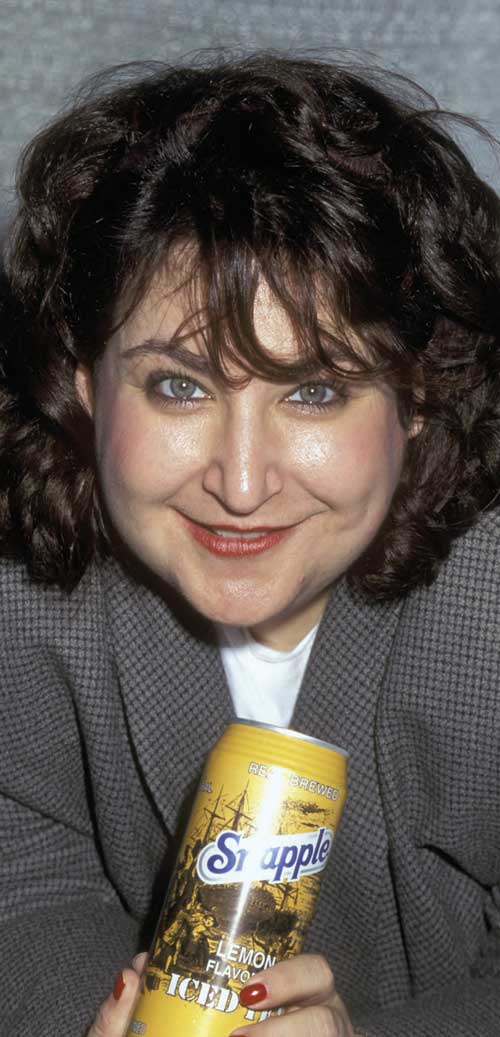
Your favorite beverage brand ambassador, Wendy Kaufman, gets candid about her deep-rooted journey of health and self-worth, life before becoming The Snapple Lady, and how special those letters truly were.
“It all really started when I was thirteen. I met a guy by the name of Michael Greenberg, who is now deceased, but he was my best friend for many years, and his father Arnie was one of the founders of Snapple. There were three owners – two of them were brothers-in-law, and they joined Arnie, who was in the health food business. He had a store on First Avenue on the Lower East Side in Manhattan, and the three friends got together to start this company called Unadulterated Foods which eventually became Snapple. They had drinks called Vitamin Supreme and really healthy stuff, and us kids could have taken whatever we wanted, but we didn’t because it was all healthy. When I was a teenager I had a great relationship with his family, they took a liking to me and became second parents in a way. When I got sick, and had a sub-stance abuse intervention, Arnie was there for me. He knew that I had been working in my family business, that I was smart, and had a great personality. So, he asked his partners if it was all right to go out of the norm and hire a friend of the family, because they had made a strict rule not to work with anyone they knew… and the partners agreed. I turned him down three times initially because I felt that I didn’t want anyone to think I was using contacts or taking the easy way out, but it was a hard time financially. I was always one of the last two or three people considered for any job I interviewed for. I always lost out because I wasn’t as pretty as the next girl, and I wouldn’t have worn a nice dress and certainly had a weight problem. That was definitely a big part of the culture back then. Soon I realized my money was running out, and Arnie had at that point come back to me and said, ‘Look, I’m not going to do you any favors. But I am going to make this your opportunity to make the job whatever you want it to be, because I think you’re going to really like the beverage business.’
It was completely a man’s business. The only women that were there were secretaries and maybe a sales person scattered around. I went into the order department, which was a great place to start meeting the distributors and learning the flavors. I truly enjoyed it, and my office was right next door to Michael’s. That was great for me because I felt very protected. For the first time there was someone believing in me more than I believed in myself. Arnie really put a lot of care, love and concern into me. I hadn’t been there very long when I noticed we were getting these letters from all over, and people were trying to get in touch with Snapple for movie product placements and other inquiries, but we didn’t have anybody in public relations.
I told Arnie, ‘I know what I want to do here,’ and I remember him telling everyone, ‘I know she’s doing something… we’re not exactly sure what it is, but she’s definitely making a difference.’ They gave me a budget and allowed me to attend school to learn computers, as everything was on the cusp of transitioning to that format. I put the letters into ten separate categories so we could answer them correctly. Companies weren’t really doing that… if you wrote to them back then, they would probably answer, ‘Thank you, here’s a sticker, here’s a coupon,’ but never answer your question. When the commercials started, which were based upon the letters, I just knew that being there for the people was critical. The letters were hand-written in the beginning, and some were very interesting and very personal – which was unexpected – they didn’t know us, they were just writing to a company, but I felt very strongly they wanted to have a relationship with us.
I did the first commercials, and then Snapple got sold to Quaker Oats. Instead of Arnie being my boss, a guy by the name of Jude Hammerle was hired as the director of marketing, and he was the one who recognized the value of the letters – what and who they were representing – and decided to do a big, authentic letters campaign. I had gotten accepted years prior to the Newhouse School of Communications at Syracuse University, which is a great school, because I wanted to be a filmmaker. My father was totally against it, but my mother said, Let her do what she wants to do, and I graduated with degrees in Film, History, and Sociology. From my education at Syracuse I knew how to be in back of the camera, and I knew what you needed in front of the camera, so I was never afraid. Before we had even been on TV, we got a letter from someone saying, ‘I love Snapple so much. I swear I am not lying,’ and that became the commercial where they hooked the guy up to a lie detector test. We didn’t change any of the letters, we kept them intact, and the ad agency came up with the idea of starring the real people in the commercials. I remember one guy sent me a picture of himself sitting on a pier and he was naked, so I wrote back, put some clothes on – you’re going to get a splinter, and I sent him a ton of Snapple clothing. But you could do that in those days. I always told everybody, ‘I don’t play the part, I am the part.’ People saw my irreverence, and they got it.
It was, in a funny way, the beginning of influencing. I really probably was the first influencer, because I was out there touting a brand and being with the people, which was very unusual a few decades ago. At the beginning of the campaign, there were a ton of meetings with all the company heads to discuss if the fat girl who started in the order department could really be in the commercials, and be the face of Snapple, because there were not a lot of people like me on television. Finally the new ad agency came in and said, ‘We want her.’ Oprah was on TV and Roseanne was incredibly popular at the time, so there were definitely some television personalities who had weight issues, and Arnie said, ‘Hey, if we’re paying the agency all sorts of money for their opinion and they want her, that’s what we should do.’ I remember calling my parents, and telling them I was going to star in the next Snapple campaign, and my mother starts screaming to my father, ‘Ronnie, get on the phone, Wendy is back on drugs.’ Then to me, ‘You’re a fat, Jewish girl from Long Island, they’re not putting you anywhere. What are you even saying?’ It was a very funny moment in my life.”
Kaufman’s path to major icon status was not an overnight success story. Frankly, it was a scenario that almost didn’t happen.
“I started my drug journey probably when I was born. At six weeks old I was on my first diet… I would fall over while my parents took pictures of me sitting on the couch because I was overfed. I was born an addict, there’s no question. Every time I would do something, if I liked it – there was no stopping. Food was the first addiction, and my second was when I was 13, and we would go to bar and bas mitzvahs, which was the circuit back then. They would have cigarettes and matches on the tables that were embossed with the kids’ names on it, and people would have alcoholic drinks, setting them down all over the place. We were all stealing everything from the tables because we didn’t care what we were drinking. At the age of 13, I started smoking, and my mother couldn’t say anything to me about that because she was a smoker too. By the time Syracuse rolled around, that’s when I found Quaaludes. Someone called me one day and asked what I was doing, and I answered, ‘Crystal meth.’ They were shocked, but I said, ‘Well, you asked.’ I was always very vocal about it, but knew something had to change.
I had even gotten engaged as part of trying to save myself. I thought if I got married I wouldn’t be an addict anymore because I’d have children and go that path, but I realized I didn’t love that guy. My choices were horrific, and I broke off that engagement. When I saw him soon after, he called me so many horrible names. I was so distraught from the whole episode that I went into my apartment, got on my knees, and asked God to kill me right then and there – or get me well. I knew I had hit my end game and couldn’t live in my own skin anymore. If I would press my cheeks my nose would bleed because I was so infected in my face. Recognizing how sick I actually was, and along with a family intervention, I signed myself into a 28-day program. They kept me for 45 days and the doctors told me, ‘If you don’t get more extensive care from an outside provider, then you are going to die.’ I knew they were right, and I went. The therapeutic community I ended up in first, is the last place that most people end up while on their sober journey… it was created for the reluctant to recover. I was 31 when I went into rehab, which turned into a ten month ordeal. My parents were adamant that I took care of it all myself. They told me, ‘You got yourself in, and now you have to get yourself out.’ I had full control of my recovery, but it hit me in my own pocket.
When I got out of treatment, working at Snapple changed everything. It all became about gratitude and each day was a bonus day that I was going to live. I am truly blessed. This year will be thirty-seven years sober for me… I should have died at 31.”
The Snapple campaign became an enormous success, turning the letter writers into co-stars themselves. This left an indelible impact on Kaufman, who never took her representation of the company lightly.
“Instead of going to tons of meetings back then, I hired a therapist who had been sober for thirty years to become my mentor, because I was nervous I would start to be discovered in the rooms of AA meetings. I also had a fear that someone would see me drinking something other than Snapple, take a photo, and I would get in trouble. It was a really hard manner of living in some ways. When Kurt Cobain died, I must have gotten sixty letters from fans of his that were distraught, and I was upset for them. I went to my therapist, and we wrote a letter back to each of those people… I didn’t dismiss any of them.
When I was younger, Tiger Beat Magazine ran a contest where they would choose one person to go on a date with Barry Williams (Greg Brady), who I was madly in love with, and I wanted to win. I entered and of course I didn’t win, but I didn’t even hear back from Tiger Beat, and that was the only fan letter I ever wrote. I thought I really deserved some kind of response if I cared enough to write a letter. When I ended up in my position at Snapple, that event was even more of an impetus to do this, because I remembered how upset I was as a kid when they didn’t even acknowledge my existence. I didn’t want anyone to feel like they didn’t count, because everyone counts! Barry Williams found out what happened, and eventually I did get to meet him. I went on The Stephanie Miller Show, and he came out on stage where he handed me several dozen roses – I fell on the floor and couldn’t even speak. Here’s what’s so great about this story – Colleen Broomall, who is an important person in my life, had written to me for Take Your Daughter to Work Day, and asked if it would be possible for me to take her with me. I did, and we had an unbelievable day. We stayed in touch for years, and when she grew up she went to work for Tiger Beat, answering letters there as part of her journey—because she had wanted to fix that part of my story. I hear from people all the time that I was a source of joy for them… if only they could do those commercials again. They were fun, they brought people together, and were something to look forward to. This world now is an alien world to me, and one quite frankly that I’m sort of disappointed in. We are supposed to be humanitarians before anything else.”
Made from the Best Stuff on Earth was Snapple’s slogan, but that catchphrase could easily also be used to describe the inherent nature of the woman behind the trademark.
“One day I took a fleeting glance in the mirror, and instead of seeing the imperfections, I saw a sparkle in my eye for the first time in my life. While I accidentally became a powerful figure in the beverage industry, I was really just trying to save myself, and found out I could do so by helping others. I was a female navigating through a male’s world, and they never really understood me… they were just there for the money and power plays. These guys spent years attempting to get me to not exist by taking me off the commercials. I went through five iterations of Snapple and kept that job until 2008, when they gave me a contract based upon no guarantees or appearances… and that’s how they got rid of me. Then through VH1, I wound up on Celebrity Fit Club, and I Love the ’90s.
They had actually cast Celebrity Fit Club, but somebody had dropped out. At the last minute, my name was mentioned as a substitute, and they contacted me. I flew out to California on the weekends we filmed it, and it became a life-changing show. On my next birthday I will be 68 years old. I left New York… I’m in Las Vegas now, and have family and friends who really love me. I went from a high of 260 pounds to 152 – I just weighed myself with clothes on – so it’s a little less than that. I did need some skin removal and a breast reduction for medical reasons, but I still walk, and purposely bought a home that had steps.”
Kaufman reflects on her time at Snapple dearly, and is never too far removed from the memories that anchored her soul with purpose.
“I’ve been tinkering with writing a memoir for twenty years… perhaps even doing a documentary. That would be the most unbelievably loving homage that I could pay to the owners of that company who always believed in me. Now I’d like the name of it to be, From Coke to Snapple, My Life in Ounces… but I’ll have to see if we can get clearance for that. It’s just a really interesting story of a regular person who ended up in the spotlight, and made a small difference in people’s lives.”